Private Label Sheet Mask: The Complete Guide for Beauty Brands in 2026
Private Label Sheet Mask: The Complete Guide for Beauty Brands in 2026
Sheet masks are one of the most commercially accessible skincare products a brand can launch — low unit cost, high perceived value, strong repeat purchase behavior, and virtually unlimited formula customization.
But the gap between a forgettable sheet mask and a hero product that drives reviews, repeat orders, and brand loyalty comes down to decisions most brands don't think about until it's too late: substrate selection, essence formula concentration, packaging integrity, and compatibility between all three.
This guide covers everything you need to know to launch a private label sheet mask that performs, complies, and sells — from substrate selection to finding the right OEM manufacturer.
What Is a Private Label Sheet Mask?
A private label sheet mask is a finished skincare product manufactured by an OEM factory and sold under your brand name. You own the brand, the packaging design, and (in most cases) the formula brief — the manufacturer handles everything from raw material sourcing to filling, sealing, and export documentation.
For beauty brands, Amazon sellers, importers, and spa professionals, private label sheet masks offer a fast, capital-efficient route to a finished product without building a manufacturing facility.
Sheet Mask Market Overview: Why Now Is a Strong Time to Launch
The global sheet mask market continues to grow steadily, driven by:
- K-beauty influence spreading to mainstream consumers in the US, Europe, and Southeast Asia
- Self-care culture making at-home treatment masks a routine purchase rather than an occasional indulgence
- Social media discoverability — masks are inherently visual and highly shareable
- Accessible price points — consumers are willing to trial new mask brands at $3–$15 per unit
- Strong repeat purchase — satisfied customers reorder consistently
For brands, sheet masks offer one of the best cost-to-retail-margin ratios in skincare. A well-positioned private label sheet mask can retail for 5–10x its manufacturing cost, especially in the premium and specialty segments.
Types of Sheet Mask Substrates: Which One Is Right for Your Brand?
The substrate — the physical sheet material — is one of the most important decisions in sheet mask development. It affects skin adhesion, essence delivery, consumer experience, and cost.
Non-Woven Fabric (Most Common)
The standard sheet mask substrate. Cost-effective, widely available, and compatible with most essence formulas. Available in varying thickness and fiber density.
Best for: entry-level to mid-range brands, high-volume SKUs, brands prioritizing cost efficiency Typical retail positioning: $2–$8 per mask
Tencel / Lyocell Fiber
A plant-derived cellulose fiber with a softer, more skin-conforming texture than standard non-woven. Better essence retention and more sustainable sourcing story. Increasingly popular with clean beauty and eco-conscious brands.
Best for: mid-range to premium brands, sustainability-focused positioning, sensitive skin lines Typical retail positioning: $5–$15 per mask
Bio-Cellulose
A naturally fermented bacterial cellulose with superior skin adhesion, high moisture retention, and a translucent appearance. Often marketed as “second skin” technology. The most premium substrate option.
Best for: luxury brands, clinical/dermatologist-recommended lines, high-end spa retail Typical retail positioning: $10–$30+ per mask
Hydrogel-Coated Non-Woven
A hybrid substrate with a hydrogel layer applied to the contact surface. Combines the cost efficiency of non-woven with improved skin adhesion and a premium sensory feel.
Best for: brands wanting a premium feel at a mid-range price point Typical retail positioning: $6–$15 per mask
Cotton / Organic Cotton
Natural cotton fiber substrates, popular with clean beauty and organic-certified lines. Softer texture, good essence absorption.
Best for: natural, organic, and clean beauty brand positioning Typical retail positioning: $5–$12 per mask
Sheet Mask Essence Formulas: Matching Formula to Skin Concern
The essence is where your mask actually delivers results. Choosing the right active ingredients for your target consumer is the most important formula decision you'll make.
Hydration and Plumping Masks
The highest-selling category globally. Formulas feature multi-weight hyaluronic acid, polyglutamic acid, beta-glucan, and squalane. Accessible to all skin types and age groups — the safest commercial bet for a first product.
Hero actives: Sodium hyaluronate, polyglutamic acid, tremella extract, ceramides Target consumer: All skin types, 20–45 age range
Brightening and Tone-Correcting Masks
Strong demand across Asian and increasingly Western markets. Addresses dark spots, uneven tone, and post-blemish marks.
Hero actives: Niacinamide, tranexamic acid, vitamin C derivatives, alpha-arbutin, kojic acid Target consumer: Hyperpigmentation, post-acne marks, dull skin
Repair and Recovery Masks
Premium segment with strong clinical positioning. Growing demand from post-procedure users, sensitive skin consumers, and brands targeting the med-spa channel.
Hero actives: PDRN, centella asiatica, peptides, panthenol, ceramides Target consumer: Post-laser, post-peel, compromised barrier, reactive skin
Acne and Problem Skin Masks
Consistent demand from the teen and young adult segment. Addresses active breakouts, oiliness, and congestion.
Hero actives: Niacinamide, salicylic acid, tea tree extract, zinc, centella Target consumer: Acne-prone, oily, combination skin, teens to 30s
Anti-Aging and Firming Masks
Targets the 35+ consumer seeking visible lifting and firming results. Premium price point with high margin potential.
Hero actives: Peptides, PDRN, retinol alternatives, multi-weight hyaluronic acid Target consumer: Mature skin, fine lines, loss of firmness
Calming and Sensitive Skin Masks
Fragrance-free, low-irritant formulas for reactive, rosacea-prone, and post-treatment skin.
Hero actives: Ectoin, madecassoside, allantoin, oat extract, beta-glucan Target consumer: Sensitive, reactive, rosacea-prone skin
How to Launch a Private Label Sheet Mask: Step-by-Step
Step 1: Define Your Product Brief
A clear brief is the foundation of a successful product development process. Before approaching manufacturers, define:
- Target skin concern and consumer profile
- Preferred substrate type
- Key actives you want included
- Scent preference (fragrance-free, light floral, unscented)
- Packaging style (pouch format, finish, box or no box)
- Target retail price and margin requirement
- Launch market and regulatory requirements
Step 2: Shortlist and Evaluate OEM Manufacturers
Not all factories have equal capability. When evaluating sheet mask manufacturers, look for:
- NMPA production license — mandatory for Chinese cosmetic manufacturers
- ISO 22716 GMP certification — confirms manufacturing quality standards
- In-house R&D team — essential for custom formula development
- Substrate sourcing transparency — can they confirm bio-cellulose or tencel origin?
- Stability and safety testing capability — required for export compliance
- Export experience — particularly important for US, EU, and Australian markets
Step 3: Request and Evaluate Samples
Physical sample evaluation should cover:
- Sheet fit — does the mask conform well to different face shapes?
- Essence load — is the mask well-saturated but not excessively dripping?
- Absorption feel — how does the essence absorb after removal?
- Scent — does it match your brief?
- Packaging integrity — is the pouch sealed properly with no leakage risk?
- Stability — request accelerated stability data at 45°C showing no separation, color change, or microbial growth
Step 4: Finalize Packaging Design
Sheet mask packaging options:
Pouch formats:
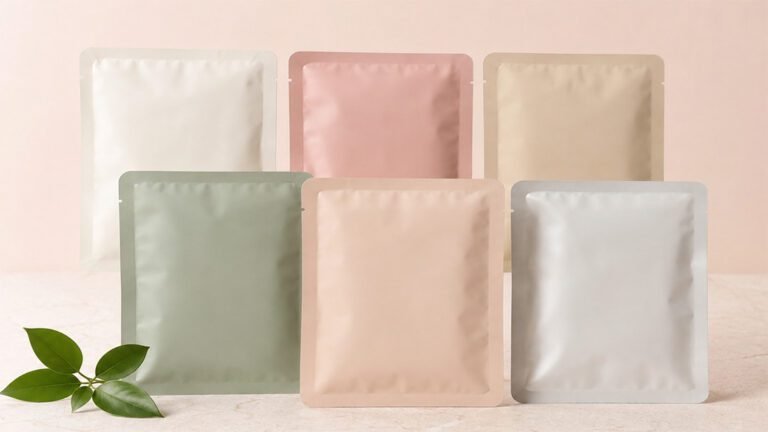
- 3-side seal flat pouch (most common)
- 4-side seal flat pouch (better seal integrity)
- Stand-up pouch (premium shelf presence)
- Die-cut shaped pouch (unique brand differentiation)
Pouch materials:
- PET/AL/PE — standard, good barrier properties
- Matte finish — premium feel
- Kraft paper laminate — natural/eco brand positioning
- Transparent window — shows mask inside
Additional packaging:
- Individual retail box (elevates perceived value)
- Multi-pack box (3-pack, 5-pack, 10-pack)
- Gift set packaging
- Travel kit formats
Step 5: Compliance and Safety Testing
For a sheet mask to be legally sold in major markets:
US Market:
- No FDA pre-market approval required for cosmetics
- Full INCI ingredient list required on label
- No drug claims (avoid language like “treats acne” — use “helps reduce the appearance of blemishes”)
- Safety test reports recommended
EU Market:
- CPNP (Cosmetic Products Notification Portal) notification required
- Product Safety Report by qualified assessor required
- Responsible Person in EU required
- Full INCI list, batch coding, and expiry date on packaging
Australia:
- AICIS (Australian Industrial Chemicals Introduction Scheme) compliance
- Standard cosmetic labeling requirements
Work with your OEM manufacturer to obtain the documentation package you need for each market.
Private Label Sheet Mask: MOQ and Pricing Guide
| Substrate Type | MOQ (units) | Typical FOB Unit Cost |
|---|---|---|
| Non-woven (stock formula) | 1,000 | $0.35–$0.80 |
| Tencel (stock formula) | 1,000 | $0.60–$1.20 |
| Bio-cellulose | 2,000–3,000 | $1.50–$3.50 |
| Hydrogel-coated | 1,500–2,000 | $0.80–$1.80 |
| Custom formula (any substrate) | 3,000–5,000 | Varies |
Prices are indicative FOB China ranges and vary based on formula complexity, packaging selection, and volume.
Production Timeline
| Stage | Timeframe |
|---|---|
| Brief review and initial quotation | 1–3 business days |
| Sample development | 2–4 weeks |
| Sample revision | 1–2 weeks per round |
| Stability and safety testing | 4 weeks |
| Bulk production after approval | 3–5 weeks |
| Total (stock formula) | 6–9 weeks |
| Total (custom formula) | 12–16 weeks |
Common Mistakes to Avoid When Launching a Private Label Sheet Mask
Choosing substrate before formula. The substrate must be compatible with your essence formula's viscosity and pH. Always finalize the formula first, then confirm substrate compatibility through testing.
Skipping stability testing. A mask that looks perfect in samples can degrade, separate, or develop microbial contamination within months. Always request accelerated stability data before committing to production.
Underestimating packaging lead time. Custom printed pouches typically require 3–4 weeks of production time on top of the mask filling lead time. Factor this into your launch timeline.
Ignoring regulatory requirements for your target market. EU and Australian requirements in particular are often underestimated by brands launching from outside those regions. Address compliance before, not after, production.
Ordering too much before market validation. Start with the minimum viable order to test consumer response. Scale volume once you have real sales data.
Why Choose Flavor Sources for Private Label Sheet Masks
At Flavor Sources, we manufacture private label sheet masks for beauty brands, Amazon sellers, importers, and spa professionals across the US, Europe, Southeast Asia, and beyond.
Our sheet mask capabilities include:
- Full substrate range: non-woven, tencel, bio-cellulose, hydrogel, cotton
- Custom and stock essence formulas across all major skin concerns
- In-house R&D team for bespoke formula development
- GMP-certified, ISO 22716 production facility
- Stability and safety testing with full documentation
- Complete export support for US, EU, AU, and Asian markets
- Low MOQ options for market entry and testing
- Full packaging design and print coordination
Explore our sheet mask manufacturing capabilities → Request a free sample → Get a project quote →
Frequently Asked Questions
What is the minimum order quantity for a private label sheet mask? Our standard MOQ starts from 1,000 units for stock formula sheet masks. Custom formula development typically requires a higher initial volume. We offer guidance on the right MOQ structure for your project and budget.
Can I use my own formula with your sheet mask manufacturing? Yes. If you have an existing formula or a detailed brief, our R&D team can work with your specifications to develop a matching formula for production. All custom formulas developed for your brand remain your intellectual property.
What is the difference between non-woven and bio-cellulose sheet masks? Non-woven is a cost-effective synthetic fiber substrate suitable for most formulas and price points. Bio-cellulose is a naturally fermented bacterial cellulose with superior skin adherence, higher moisture retention, and a more premium skin feel — typically positioned at a higher retail price.
Do you offer fragrance-free sheet mask formulas? Yes. We regularly produce fragrance-free and hypoallergenic formulas for sensitive skin lines and clean beauty brands. We can also formulate to avoid common sensitizers upon request.
Can you produce sheet masks suitable for the EU market? Yes. We provide full technical documentation for EU CPNP notification including Product Information File components: INCI list, safety test reports, stability data, and CoA. We can also advise on EU responsible person requirements.
How do I get started with a sheet mask project? The simplest first step is to request a sample from our existing formula range, or submit your brief and we'll respond with recommendations and an initial quotation within 1–2 business days.
Ready to Launch Your Private Label Sheet Mask?
Sheet masks remain one of the best-performing entry products for beauty brands — accessible to manufacture, easy to differentiate through formula and packaging, and trusted by consumers across every major market.
Flavor Sources gives you the manufacturing capability, formulation expertise, and export infrastructure to bring your sheet mask to market efficiently and compliantly.